
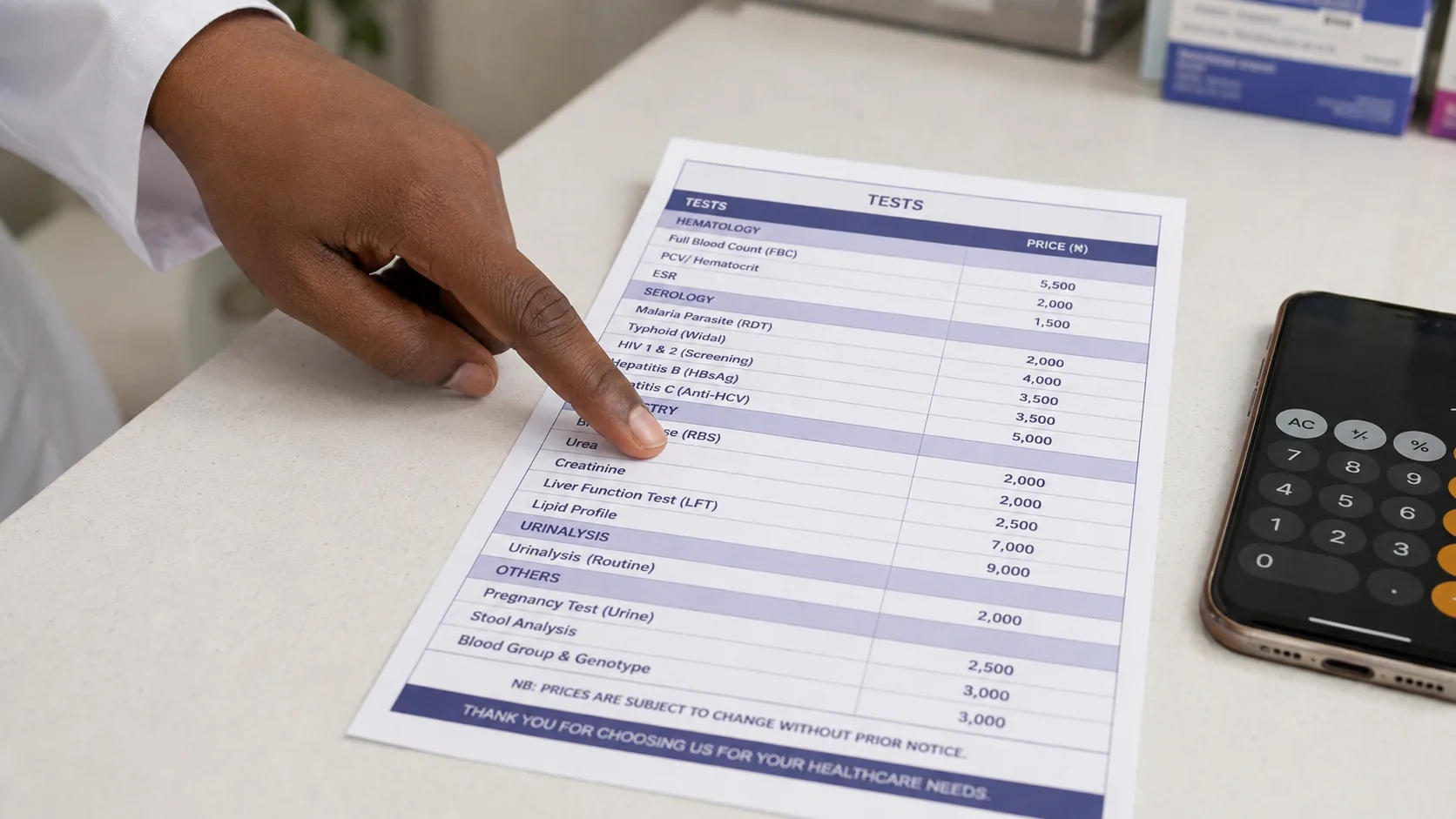
Ask what a blood test costs in Lagos and you will get answers ranging from a few thousand naira to several hundred thousand, often for tests with similar sounding names. That spread is confusing, and it makes people either overpay or avoid testing altogether.
This guide breaks down what actually drives the price of a laboratory test, what common investigations should cost, and how to make sure you are paying for tests you genuinely need.
What you are actually paying for
A laboratory test price is not arbitrary. It reflects a fairly predictable set of inputs, and understanding them makes the range across tests far less mysterious.
- Reagents and consumables. Some tests use inexpensive, widely available reagents. Others use antibody-based kits that are imported, temperature-sensitive and costly per sample.
- Equipment. An automated haematology analyser processes a full blood count in seconds. A molecular platform for viral load testing costs orders of magnitude more to buy, run and maintain.
- Technical time. Manual microscopy, culture setup and reading, and histopathology all consume trained personnel time that automation does not.
- Batching. Tests run daily in large batches spread their fixed costs widely. Specialised assays run less often carry more of that cost per sample.
- Turnaround. Genuinely urgent processing interrupts batch workflow, which is why same-day handling of certain specialist tests can cost more.
This is why a malaria parasite test and a fertility hormone profile differ so widely in price. They are not the same kind of work.
What common tests cost
Rather than repeat numbers that drift out of date, we publish our full catalogue with live prices, plain-language descriptions of what each test checks and turnaround times on our book a test page. You can search it, group by category and build a running total before you commit to anything.
As a general shape, expect routine screening tests such as malaria parasite, urinalysis, fasting blood sugar and pregnancy testing at the lower end. Standard chemistry panels such as liver and kidney function sit in the middle. Hormonal assays, cancer markers, fertility profiles and comprehensive wellness packages sit at the upper end, reflecting the reagent and platform costs behind them.
Profiles usually cost less than the sum of their parts
If you need several related tests, a profile can sometimes provide better value and simpler planning when the bundled investigations match what you actually need. Compare the included tests with your clinician’s request or your screening objective before choosing a package.
The same logic can apply to pre-employment and executive screening. A structured profile can simplify budgeting and ensure a consistent agreed scope; the team should confirm pricing for the actual programme rather than assume one package fits every role.
How to avoid paying for tests you do not need
The single most useful question to ask before any test is: what would change depending on the result? If the honest answer is nothing, the test may not be worth doing yet.
- 01
Bring your referral or request form. Doctors order specific tests for specific reasons, and the form prevents duplication.
- 02
Mention recent tests. If you had a full blood count three weeks ago, repeating it may add nothing.
- 03
Ask whether a profile covers what you need, rather than adding tests one by one.
- 04
Be clear about your purpose. Screening, monitoring a known condition, and investigating symptoms call for different tests.
- 05
Ask what preparation is required, so you do not pay twice because a fasting test was done after breakfast.
A good laboratory will talk you out of a test as readily as into one. If that conversation is not on offer, it is worth asking why.
Why transparent pricing matters
Published prices do more than help you budget. They change the relationship. When the cost of every test is visible before you walk in, you can plan, compare and decide without pressure at the counter, and you can see exactly what a recommendation would cost you.
It also protects the laboratory. Clear prices mean fewer disputes, fewer surprises and fewer people delaying tests they need because they cannot estimate the cost. That is the reason our full catalogue is public rather than quoted on request.


